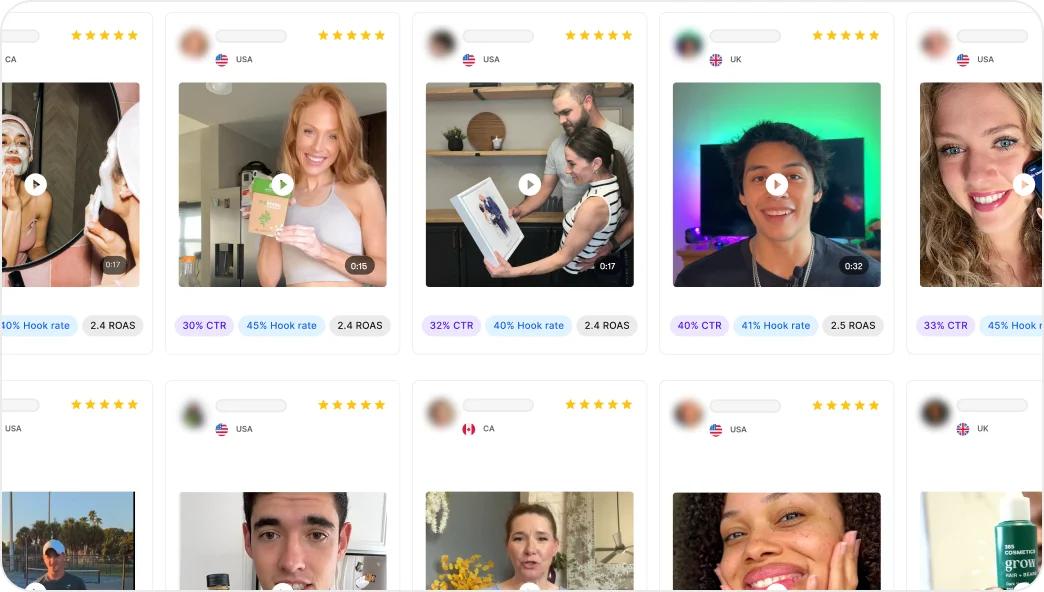
How Brands Use UGC Reactions to Increase Click-Through Rates
 Daniel Hangan3 min read
Brands use UGC reaction videos to increase click-through rates because reactions feel authentic, grab attention in the first seconds, and create instant trust—making users more likely to click.
Scroll-based platforms like TikTok, Instagram, and Meta have changed how ads compete for attention. Users don’t read ads; they react to them in seconds.
That’s why UGC reaction videos have become one of the most effective formats for increasing click-through rates (CTR) in paid social campaigns.
In this article, we’ll break down how brands use UGC reactions to drive higher CTR, why this format works so well psychologically, and how performance teams apply it in real campaigns.
What Are UGC Reaction Videos?
UGC reaction videos are short-form clips where real people react to a product, ad, or experience. Unlike scripted testimonials, reactions are designed to feel spontaneous and emotionally honest.
Common formats include:
- First-time product reactions
- “I didn’t expect this” moments
- Live responses to an offer or feature
- Before-and-after style reactions
The goal isn’t perfection, it’s believability.
Why Click-Through Rate Matters So Much
CTR is more than a vanity metric.
A higher click-through rate:
- Signals relevance to ad platforms
- Lowers CPMs over time
- Improves delivery and scale
- Increases the chances of profitable campaigns
UGC reactions directly influence CTR by changing how ads are perceived in the feed.
Why UGC Reactions Work Better Than Traditional Ads
1. Reactions Stop the Scroll
Humans are wired to notice faces and emotions.
UGC reactions:
- Show surprise, curiosity, excitement, or disbelief
- Create visual contrast in the feed
- Trigger instinctive attention
This “pattern break” is often enough to win the first "second", which is critical for CTR.
2. They Build Instant Credibility
A reaction feels unscripted, even when guided.
Viewers subconsciously think:
“This looks like a real response, not a brand claim.”
That perceived honesty lowers skepticism and makes users more willing to click to learn more.
3. Reactions Act as Social Proof
UGC reactions signal that:
- Someone else has already tried this
- The product or offer is worth reacting to
- The experience feels relatable
This reduces friction and encourages action, especially in cold traffic campaigns.
How Brands Use UGC Reactions to Boost CTR
1. Leading With the Reaction, Not the Product
High-performing ads often open with:
- The creator’s face
- An emotional response
- A short, curiosity-driven statement
The product comes after attention is earned.
This approach consistently outperforms those that focus on logos or feature-heavy introductions.
2. Testing Multiple Reaction Styles
Brands don’t rely on one reaction.
They test:
- Shock vs excitement
- Calm vs expressive creators
- Confident vs curious tones
UGC reactions are inexpensive and fast to produce, making this type of testing practical.
3. Matching Reactions to Ad Angles
Different reactions support different messages:
- Surprise → strong hooks
- Relief → problem–solution offers
- Excitement → promotions or launches
Aligning emotion with the ad angle improves relevance and CTR.
4. Using Reactions as Thumbnails and Hooks
Even when users don’t watch the full video, reaction frames:
- Improve visual engagement
- Increase curiosity
- Encourage clicks
A strong reaction face often does more than text overlays.
Why UGC Reactions Perform So Well on TikTok & Meta
Platforms reward content that:
- Feels native
- Generates early engagement
- Holds attention
UGC reactions naturally align with these signals, which helps ads:
- Enter auctions more competitively
- Reach more users at a lower cost
- Scale faster once CTR improves
Where Platforms Like UGC Humans and Dan’s UGC Models Fit In
UGC-focused platforms make reaction testing scalable.
They help brands:
- Source real human creators
- Generate multiple reaction variations quickly
- Launch creatives without long production cycles
For CTR-focused campaigns, this speed and flexibility are a major advantage.
Best Practices for Using UGC Reactions
- Keep videos short (15–30 seconds)
- Start with emotion, not explanation
- Avoid over-scripting
- Test multiple creators
- Optimize for the first 3 seconds
Small changes in reactions can produce large CTR swings.
Final Thoughts
UGC reaction videos work because they tap into something traditional ads often miss: human response.
By showing how real people react, not just what brands claim, UGC reactions:
- Capture attention faster
- Build trust instantly
- Increase click-through rates consistently
In crowded social feeds, reactions aren’t just creative, they’re a performance lever.