UGC ad fatigue: diagnose Meta and TikTok app creatives
Diagnose creative fatigue in Meta and TikTok mobile-app ads before buying more footage. Check measurement, the app funnel, and the creative hypothesis.

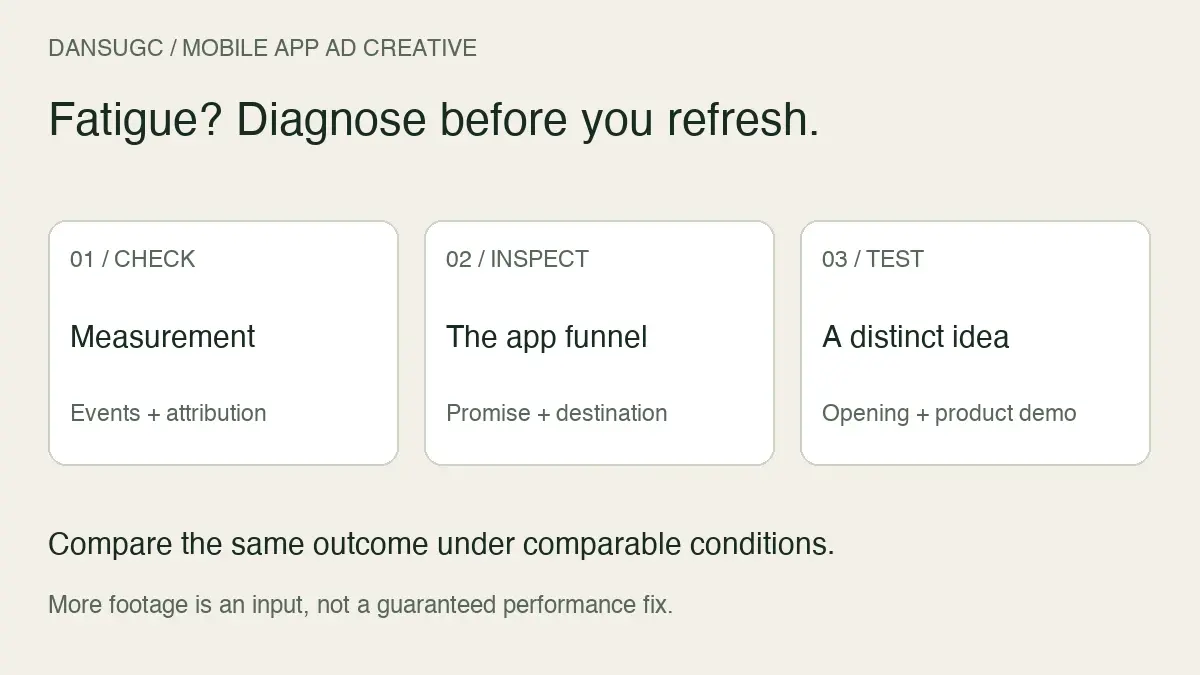
UGC ad fatigue is a decline in response as an audience becomes familiar with an ad. For mobile-app teams running Meta or TikTok ads, treat it as a diagnosis to investigate, not the automatic explanation for higher acquisition costs. Compare the same creative over comparable periods, check tracking and the app funnel, then test a meaningfully different opening or concept. More footage helps when creative is the bottleneck; it cannot repair a broken checkout or misleading offer.
I’m Daniel Hangan, founder of DansUGC. We supply human reaction footage and B-roll. This guide separates the decision to refresh an ad from the decision to buy more clips. The examples are illustrative, not results from a measured client experiment.
How do you know whether an app ad is fatigued?
A previously useful creative losing attention and customer outcomes under reasonably comparable conditions is a reason to investigate fatigue. One expensive day, high frequency alone, or an ad that never worked is not enough to establish it.
Start with a simple record for each creative: launch date, concept, opening, product demo, audience, placement, spend, impressions, reach, clicks, installs, and the downstream event that matters to your business. Keep the event definition and reporting window consistent. An install and a first paid subscription are not interchangeable conversions.
Look at the pattern rather than one number:
- Attention: are viewers leaving earlier than before? Compare the same video-view metric within the same platform, not differently defined rates across platforms.
- Response: is outbound or destination click-through falling? Use the same click definition in each comparison.
- Exposure: is frequency increasing while reach grows slowly? Examine the same time window and level of reporting.
- Business outcome: are cost per install and cost per paying customer moving together, or is the deterioration happening after installation?
- Distribution: did the mix of placements, countries, devices, or audiences change?
These are clues, not proof of causation. Average frequency does not tell you that every person saw the ad equally often. A short period with very few purchases can produce a large apparent CPA swing from one additional sale.
TikTok’s creative best-practice guidance recommends regular performance review and creative refresh when results decline consistently or daily new users are low. It also recommends maintaining creative assets. That supports a monitored production process, not a universal rule that every ad expires on a particular day.
Check four alternative explanations before replacing the video
1. Measurement changed
Check whether the conversion event, attribution window, consent handling, or reporting connection changed. Compare aggregate reported purchases with your payment records using aligned dates and time zones. They need not match exactly: attribution and reporting delays differ. An abrupt discrepancy still deserves investigation before you blame the footage.
For a subscription app, separate a trial start, first collected subscription payment, renewal, and refund. If your acquisition report starts counting renewals as new customers, neither your baseline nor your creative comparison is reliable.
2. The post-click journey deteriorated
Open the actual destination on a phone. Follow the path from ad to store listing or landing page, installation or signup, onboarding, and the subscription offer. Check for broken links, slow loading, a changed paywall, unavailable features, and a promise the product does not fulfill.
If clicks remain useful but fewer visitors complete signup, a new reaction shot may leave the real problem untouched. If installs hold up but first payments fall, investigate activation, offer fit, and payment completion as well as acquisition quality.
3. Delivery conditions changed
Review changes to budget, targeting, placement mix, and auction costs. Compare affected creatives with other established ads where conditions are reasonably similar. A broad increase in CPM is a different signal from one video's response declining while peers remain stable.
Do not label every account-wide movement an auction problem, either. Record the evidence and what remains uncertain. Several factors can change together.
4. The concept never worked
An ad that has been weak since launch may have a message, audience, or product-demonstration problem. Calling it fatigued implies it once performed acceptably. If there is no credible baseline, review the concept before making cosmetic variations.
Ask whether a viewer can identify the app’s use case, see the feature in action, and understand the next step. A surprising face may earn attention without attracting people who need the app.
A practical diagnosis worksheet for mobile-app teams
Write one short note before commissioning another batch:
- Observed change: what deteriorated, over which dates, and with how many underlying events?
- Comparison: which earlier period or other creative is a reasonable reference, and what differs?
- Checks completed: measurement, destination, app version, offer, and delivery changes.
- Working explanation: fatigue, weak concept, post-click friction, measurement, mixed causes, or insufficient evidence.
- Next test: the smallest meaningful creative change that addresses the explanation.
- Decision rule: the business outcome, review window, and spend limit your team will use before seeing the result.
This is a decision record, not an automated diagnosis. Avoid declaring a winner just because the first few clicks look cheaper. When a controlled comparison is needed, use a suitable experiment design rather than assuming two concurrently running ads received equivalent audiences or spend.
What should you change in a fatigued UGC ad?
Change the part responsible for the hypothesis. A new caption, a different person, and a different concept are three different interventions.
If the opening is the concern, keep the accurate app demonstration and destination stable while testing a distinct opening. If the promise is weak, change the use case and build a demonstration that supports the new promise. If the demonstration is unclear, fix it before sourcing more faces.
For example, imagine a planning app whose original ad opens with a surprised reaction and then shows a calendar. These are hypothetical alternatives:
- Task-first: start with the actual task of organizing tomorrow’s work, then show the app completing it.
- Problem-first: show an ordinary planning frustration, then demonstrate the relevant feature without exaggerating its effect.
- Reaction-first: use a different, appropriate human reaction to introduce the same task, followed immediately by the product demonstration.
Label the edits by concept and version. A change in clothing or music can be worth testing, but it does not automatically make the underlying message new. Do not describe three exports of the same idea as three independent concepts.
Our app reaction-ad storyboard gives the shot sequence. The UGC hook examples help pair an opening line with a shot. Use both as creative starting points, not proven performance formulas.
Where ready-made UGC footage fits
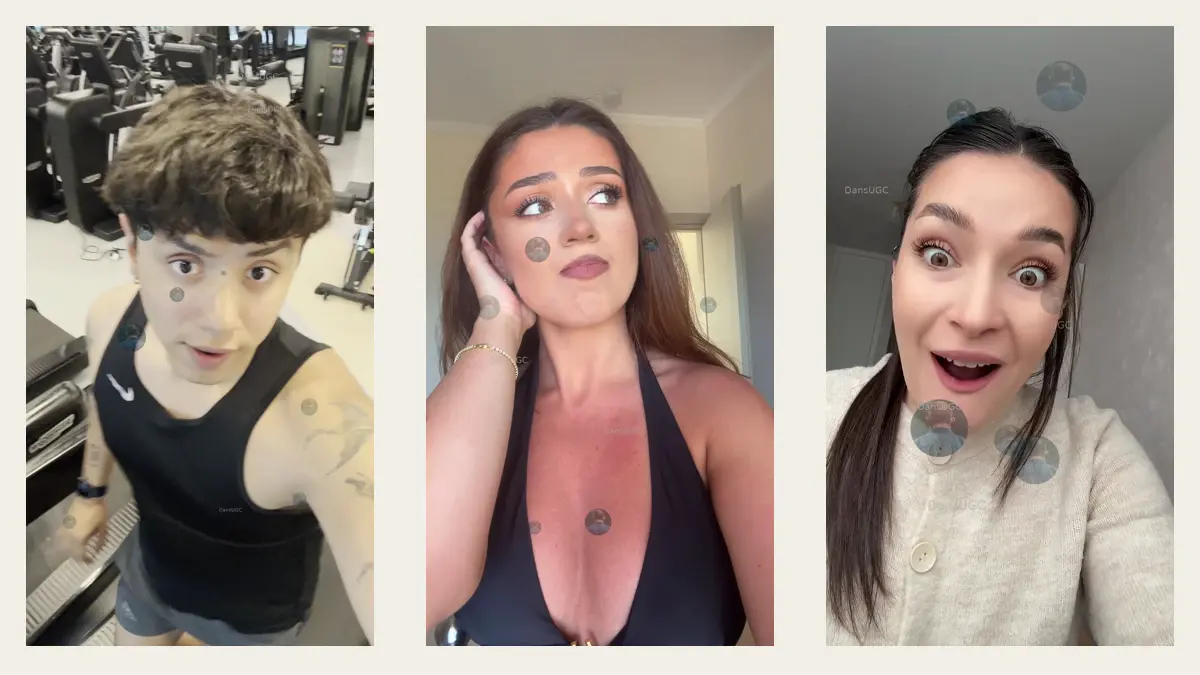
The DansUGC B-roll library provides real-human clips you can preview while planning a new opening. A library is useful when the missing input is an appropriate reaction or contextual shot. It is not a substitute for product-specific footage or an authentic customer account.
Before buying, shortlist against the actual brief: emotion, setting, crop, usable duration, transition into the demo, and intended use. Check the individual asset and current commercial terms for your channels and campaign period. Do not assume all files or all purchases carry identical specifications or rights.
A licensed reaction does not prove the performer uses your app. Avoid putting invented first-person experience into their mouth through captions or voiceover. Show the real product workflow and keep illustrative performance distinct from customer testimony.
Keep the source clip, permission record, demo version, final export, and approval together. The app-studio production workflow covers this handoff. Here, the key is that the replacement creative should answer a documented problem rather than fill a quota.
How often should you review and refresh?
Use a review cadence your spend, conversion delay, and production lead time justify. A high-spend account may need daily operational checks; a low-volume test may need longer before its outcome can be interpreted. Neither should manufacture certainty from an arbitrary number of days.
Distinguish monitoring from intervention. Checking delivery does not mean editing the campaign every time a metric moves. Keep a dated change log so you can tell whether a creative decline preceded or followed another change.
Prepare candidate concepts before the team urgently needs them, but replace or reduce exposure based on evidence and business constraints. Keep the prior creative and its history in the asset library. An old winner is a reference, not a guarantee that relaunching it will work again.
Frequently asked questions
Is higher frequency proof of creative fatigue?
No. It describes repeated exposure over a selected period. Interpret it alongside reach, response, customer outcomes, audience type, and changes in delivery. Do not use a single universal frequency number as an automatic pause rule.
Can UGC clips fix high cost per app install?
They can supply new creative inputs, but cannot guarantee lower CPI. First check whether the problem is the creative, audience, store listing, offer, measurement, or another part of the acquisition journey. Judge the edit by the outcome your business needs, not cheap clicks alone.
Should Meta and TikTok use the same creative?
They can share source footage and a truthful product demonstration. Review the finished version in each intended placement: crop, captions, interface overlays, sound, and destination. Evaluate platform-specific results separately instead of assuming the same export or metric definition transfers unchanged.
How do I tell fatigue from a bad creative?
Look for an established useful baseline followed by deterioration under reasonably comparable conditions. A creative that never produced useful response is better treated as an unproven or weak concept. Neither diagnosis should rest on a handful of clicks.
If the diagnosis points to a missing human opening, preview reaction clips for your next app-ad brief. Start with the scene and the claim you need to support. Buy footage to answer that brief, not because a calendar says the old ad must be tired.
Ready to get UGC videos for your brand?
Real human creators, 48-hour delivery, 12-month commercial license. Starting at $9/video.